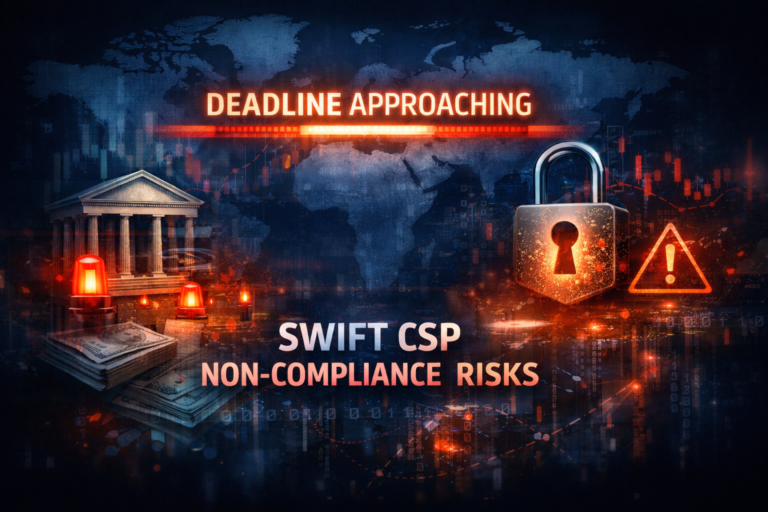
What Happens If You Don’t Meet Your SWIFT CSP Deadline?
Why SWIFT CSP Deadline Compliance Is Critical to Global Payment Security
Global finance operates at extraordinary speed, enabled by systems such as SWIFT, the Society for Worldwide Interbank Financial Telecommunication. Trillions of dollars move across borders each day through this network, making it a foundational component of the international banking system. The SWIFT Customer Security Programme (CSP) exists to address this reality. It is a mandatory, annual baseline security framework designed to ensure that every connected institution meets minimum cybersecurity expectations defined in the Customer Security Controls Framework. In our decade of CSP support, we have seen many financial organizations struggle to meet the annual attestation date, leading many to wonder: What happens if our institution misses the SWIFT CSP Deadline?
This attestation is not administrative housekeeping. It is a contractual and risk-based commitment to the collective security of the global financial ecosystem. When an institution fails to submit its attestation, or submits one that is incomplete or non-compliant, the consequences extend well beyond the IT function and can escalate rapidly into a business and regulatory crisis.
The Immediate Fallout: Flags, Reporting, and Scrutiny
Regulatory Notification and Escalation
The most immediate consequence of missing the SWIFT CSP attestation deadline is regulatory exposure. SWIFT policy requires that instances of non-submission or non-compliance be reported to relevant local supervisory and regulatory authorities.
This notification serves as a formal signal that the institution may be operating with material security gaps in a systemically important financial network. Once alerted, regulators may initiate enforcement actions that include:
Targeted or full-scope cybersecurity and IT risk audits
Expanded supervisory reviews beyond SWIFT-related systems
Remediation mandates with fixed deadlines and reporting obligations
Financial penalties or sanctions for failure to meet regulatory cybersecurity expectations
How Non-Compliance Triggers Regulatory and Supervisory Scrutiny
While SWIFT itself does not levy fines, regulatory actions triggered by CSP non-compliance can result in costs that significantly exceed the effort required to achieve timely compliance. The operational disruption, management time, and reputational exposure associated with regulatory intervention are often underestimated until they materialize.
Visible Non-Compliance Within the SWIFT Community
Non-compliance is not only visible to regulators. Within the SWIFT ecosystem, attestation status is commonly exposed to counterparties through the KYC Security Attestation application.
How Counterparties Interpret an Expired or Missing Attestation
An expired, late, or missing attestation functions as a clear risk signal to correspondent banks and payment partners. From their perspective, it raises concerns around fraud exposure, operational risk, and shared liability.
Correspondent Banking De-Risking Driven by SWIFT CSP Failures
Key counterparty-driven risks include:
Increased due diligence requests and security questionnaires
Reduced transaction volumes or imposed transaction limits
Higher fees to compensate for perceived risk
Termination of correspondent banking relationships in severe cases
De-risking decisions are often commercial and unilateral. Once initiated, they can be difficult to reverse, even after compliance is restored. Loss of correspondent access can severely impair an institution’s ability to conduct cross-border payments and settlements.

Long-Term Damage: Operational and Reputational Impact
Risk of SWIFT Access Restriction
In cases of prolonged or serious non-compliance, SWIFT retains the authority to restrict or suspend access to the network. While this is a measure of last resort, it remains a real risk for institutions that fail to remediate identified deficiencies.
The operational consequences of SWIFT access suspension are severe:
Inability to send or receive cross-border payment messages
Disruption to trade finance, treasury, and settlement operations
Frozen client transactions and liquidity bottlenecks
Significant financial losses and client attrition
Even a temporary suspension can have cascading effects across business lines, counterparties, and client trust. Recovery is rarely immediate and often requires external validation before access is reinstated.
Reputational Erosion and Financial Exposure
Beyond operational risk, non-compliance damages the most critical asset in financial services: trust. A known failure to meet SWIFT CSP obligations signals weak governance and inadequate cybersecurity controls to clients, investors, insurers, and regulators.
Impact on Client Trust, Market Confidence, and Growth
Long-term consequences commonly include:
Loss of confidence among corporate and institutional clients
Reduced ability to win new mandates or onboard high-value clients
Increased cyber-insurance premiums or denial of coverage
Heightened scrutiny in future regulatory examinations
In competitive financial markets, reputational damage often outlasts the technical remediation of control gaps. Institutions may remain flagged as higher risk long after compliance is formally restored.
The Way Forward: Prioritizing Proactive Compliance
The story of the late attestation is a clear reminder that cybersecurity compliance is not a discretionary IT project; it is a critical business function. The SWIFT CSP is a baseline defense for the entire global financial ecosystem.
For any institution connected to the SWIFT network, the path forward is clear: treat the annual attestation process, including the now-mandatory independent assessment, as a year-round priority. Proactive gap analysis, early remediation of controls, and a planned submission well ahead of the December deadline are the only ways to avoid the severe penalties of regulatory intervention, correspondent de-risking, operational paralysis, and the irreversible destruction of trust. In the high-stakes world of global payments, complacency is a luxury no one can afford.

About World Informatix Cyber Security
World Informatix Cyber Security (WICS) has helped financial institutions of all sizes – from small regional banks to Central Banks and the United Nations, navigate the SWIFT Customer Security Programme since 2016.
As one of the original CSP assessors and the lead incident response from the largest SWIFT attack at the Central Bank of Bangladesh in 2016, our experience provides a comprehensive and holistic approach to security the SWIFT payment system.
We Are Ready To Support Your Needs