SWIFT Customer Security Controls Framework (CSCF)
What is the SWIFT CSCF

As a result of continued attacks and threats to the financial industry, the Society for Worldwide Interbank Financial Telecommunication has created the SWIFT Customer Security Controls Framework (CSCF) as the global baseline that every SWIFT-connected institution must follow to protect the confidentiality, integrity, and availability of financial messaging. The framework is an integral part of the Customer Security Program (CSP) which all institutions using SWIFT must annually attest to compliance with the Customer Security Controls Framework by December 31st of each year.
Objectives and Controls of CSCF
The CSCF defines three core objectives, eight principles, and 32 security controls, which include both mandatory and advisory requirements tailored to each user’s SWIFT architecture and infrastructure.
1. Secure Your Local Environment
Minimize attack surfaces, harden systems, and ensure secure configurations across all components
2. Prevent and Detect Fraudulent Messages
Use layered authentication, access protections, and validation controls to reduce the risk of unauthorized transfers or manipulation of payment workflows.
3. Ensure Operational Resilience
Maintain continuity, monitoring, logging, and incident response capabilities so institutions can quickly detect, contain, and recover from cyber events.
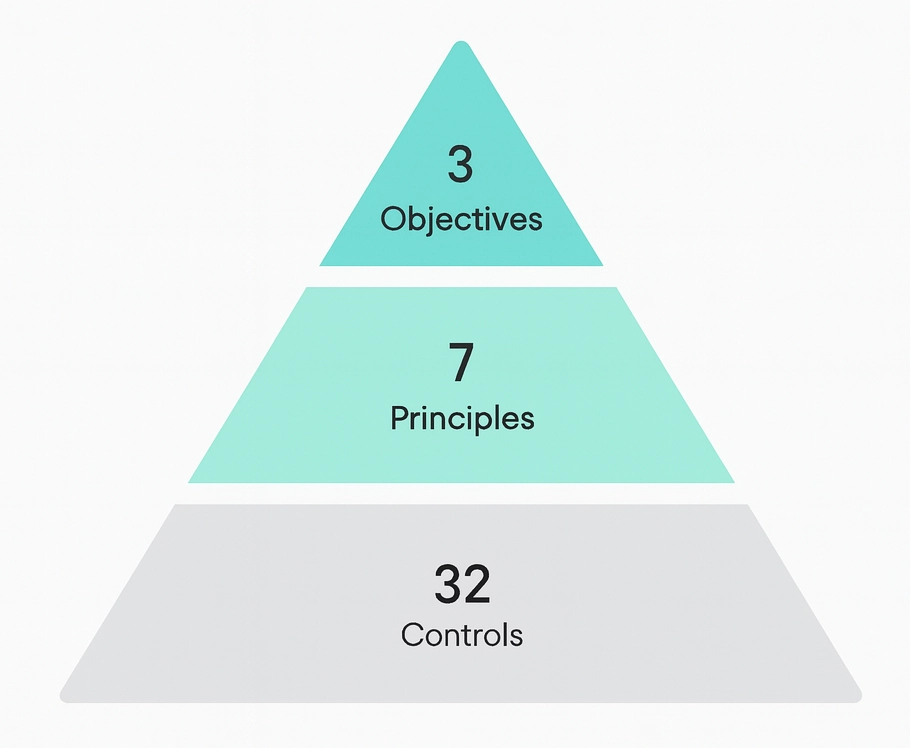
Insight Into CSCF Princples
The Customer Security Controls Framework groups seven princples into the three core objectives, defining the scope, risks and expected security measures that any financial institution must meet. The CSCF is updated each year, providing new guidance on the scope, requirements and guidelines for financial institutions. Our summary of 2026 changes can be viewed below:
1. Secure Your Environment
This principle ensures the SWIFT infrastructure is isolated, hardened, and protected from internal and external attack surfaces. It introduces architectural and configuration-level defenses to prevent compromise before it can occur.
Controls
1.1 Restrict Internet Access
1.2 Segregate SWIFT-related Components
1.3 Reduce Attack Surface and Hardening
1.4 System Architecture Security
1.5 Physical Security
2. Know and Limit Access
Ensures that only appropriately authorized and authenticated individuals can access SWIFT systems, and that access entitlements follow the principle of least privilege.
Controls
2.1 Password and Authentication Policy
2.2 Multi-Factor Authentication
2.3 Role-Based Access Controls
2.4 Privileged Access Management
2.5 Account Lifecycle Management
3. Detect Anomalous Activity
Provides visibility into suspicious or abnormal behavior inside the SWIFT environment. Continuous monitoring and logging are required to detect threats, misuse, or operational anomalies.
Controls
3.1 Logging and Security Event Recording
3.2 Daily Log Review
3.3 Intrusion Detection and Monitoring
3.4 Malware & Integrity Monitoring
3.5 Time Synchronization
4. Protect Critical Data and Financial Messaging
Ensures the integrity, confidentiality, and accuracy of SWIFT payment messages and workflows. Controls prevent unauthorized manipulation and validate that messages are legitimate.
Controls
4.1 Transaction Integrity Controls
4.2 Message Validation Processes
4.3 Secure File Transfers
4.4 Multi-Level Transaction Approval
4.5 Dual Control Over Sensitive Operations
5. Ensure Dependency and Service Provider Security
Requires institutions to govern and secure any external service providers involved with SWIFT operations. The goal is to prevent third-party weaknesses from becoming SWIFT vulnerabilities.
Controls
5.1 Third-Party Risk Assessment
5.2 Contractual Security Requirements
5.3 Ongoing Service Provider Oversight
5.4 SWIFT Connectivity Outsourcing Governance
6. Prepare and Respond to Cyber Incidents
Ensures institutions maintain a tested, actionable incident response plan specific to SWIFT systems. The goal is to minimize impact, accelerate containment, and communicate effectively.
Controls
6.1 Incident Management Process
6.2 Crisis Communications Procedures
6.3 Post-Incident Review and Control Improvements
6.4 Cyber Threat Intelligence Usage
7. Ensure Operational Resilience
Strengthens an institution’s ability to continue SWIFT operations during disruptions. It covers backup, recovery, service continuity, and system availability under various scenarios.
Controls
7.1 Backup & Recovery
7.2 Business Continuity Planning
7.3 Capacity & Performance Monitoring
7.4 Environmental Controls (power, HVAC, availability)
7.5 Operator Training & Competency
How Do We Approach The CSCF Assessment

World Informatix has created a comprehensive custom security controls security checklist. Drawing upon our real-world experience, our checklist is mapped directly to ISO 27001 and NIST CSF detailed controls, providing a more audit-oriented approach to security compliance and assurance.
Service Overview FAQ
Is SWIFT CSP an audit framework, a certification, or a self-attestation?
SWIFT CSP is not a certification or traditional audit. It is a self-attestation program supported by an increasingly required independent assessment to validate that CSCF controls are properly implemented.
Does the framework apply only to SWIFT-connected systems or the entire IT environment?
The CSCF covers all SWIFT-connected systems and any supporting infrastructure that directly affects SWIFT operations, including authentication services, network segments, jump hosts, secure zones, logging systems, and interfaces. If a component can influence the confidentiality, integrity, or availability of SWIFT messaging, it is considered in scope.
What evidence is required to demonstrate compliance with each CSCF control?
Institutions must provide documented policies, system configurations, architectural diagrams, access control records, log samples, monitoring outputs, and operational procedures that demonstrate each control is fully implemented and functioning effectively. Evidence must show both design and operating effectiveness, not documentation alone.
How long does a SWIFT CSP assessment take, and what internal resources are needed?
What happens if our institution does not meet all mandatory CSCF controls?
Non-compliance must be disclosed in the annual attestation, and institutions are expected to produce remediation plans and address gaps promptly. Failure to comply can trigger SWIFT follow-up, impact correspondent banking relationships, and increase audit and regulatory scrutiny.
Do advisory controls eventually become mandatory, and how often does SWIFT update the framework?
Yes. SWIFT regularly elevates selected advisory controls to mandatory status as the threat landscape evolves. CSCF updates occur annually, and institutions should monitor roadmap changes to ensure future readiness and avoid last-minute remediation efforts.
Why should we use an independent assessor, and what value does an external assessment provide beyond self-attestation?
An independent assessor provides objective validation, identifies gaps early, and ensures institutions interpret the CSCF correctly. Assessors also provide guidance on compensating controls, architectural design, evidence quality, and remediation—substantially reducing compliance risk and strengthening the accuracy of the final attestation.
World Informatix employs SWIFT certified assessors and can be found in the SWIFT Directory of Certified Assessors.
WHY CHOOSE US
Explore our Knowledge Base
Learn more about SWIFT related topics in our knowledge center.